
At some point, most small business owners have the same conversation with a digital agency. It goes something like this: the agency presents a proposal. The proposal is impressive — brand strategy, content calendar, SEO audit, redesigned website, maybe a social media package. The price is significant. You sign because it feels like the right move. The work begins.
Months later, you have a website that looks better. You have a brand guide you've never opened. You have a content calendar someone else built that doesn't quite sound like you. And the phone is ringing about the same amount it was before.
You're not alone in this experience. And it's not because you hired the wrong agency.
It's because most agencies sold you a strategy when what you needed was infrastructure.
The Difference Between Strategy and Infrastructure
Strategy is about direction. It answers questions like: who is your customer, what do you stand for, how do you want to be perceived? These are real and important questions. But for most small businesses, they're not the bottleneck.
The bottleneck is infrastructure. It's the gap between "a potential customer finds you" and "that customer becomes a booked job." It's the broken contact form. The website that takes eight seconds to load on a phone. The quote request that lands in a generic inbox nobody checks before 9am. The follow-up that never happens because there's no system to trigger it.
No amount of brand strategy closes that gap. A coherent, connected digital system does.
When I say "system," I don't mean software stacks and technical architecture. I mean something simpler and more practical: every piece of your digital presence working together, so that a person who is ready to hire you can find you, trust you, and reach you — without anything falling through the cracks.
What Small Businesses Actually Need
Think about what happens when a homeowner decides to hire a power washing company on a Tuesday night. They search. They skim through two or three results. They land on a website. In about thirty seconds, they decide whether to keep reading or go back and click the next result.
What keeps them reading? Not the mission statement. Not the brand story. The practical signals: the site loads fast, the services are clearly described, there's a way to request a quote without picking up the phone, and the business looks like a real professional operation. That's it.
What converts them into a customer? A path from "I'm interested" to "I've made contact" that has no friction and no dead ends. A response — from an AI assistant, an automated acknowledgment, a human — that happens quickly enough that they don't move on to the next option.
This is infrastructure. And most small businesses don't have it, not because they can't afford it, but because nobody has ever built it for them deliberately.
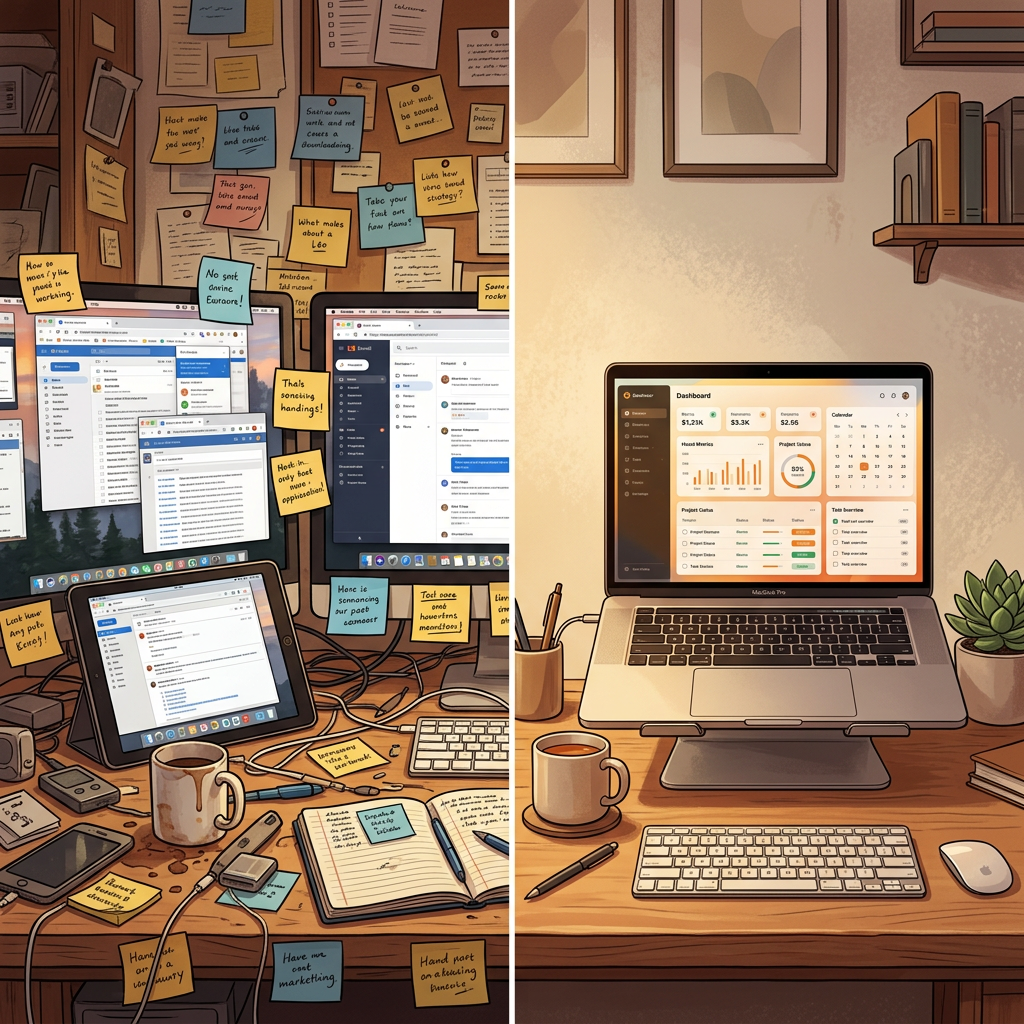
!A split view: chaotic digital workspace on the left, clean and unified on the right.
Why Agencies Miss This
Big agencies are optimized for big clients. Their processes, their team structures, their deliverables — all of it is designed around organizations with dedicated marketing departments, existing brand guidelines, and enough complexity to justify a six-figure retainer.
When a small service business walks through the door, agencies often apply the same playbook at a smaller price point. You get a junior team instead of a senior one. You get the brand sprint condensed into two weeks instead of eight. You get deliverables that were designed for a different kind of client.
What you rarely get is someone who sits down and asks: how does your business actually work? Where do leads come from today? What happens when someone fills out your contact form? What's the gap between what your website promises and what a customer actually experiences when they try to reach you?
Those questions aren't strategic. They're operational. And answering them — then building something that addresses the answers — is what Ember Pulse Studios was built to do.
A Connected System, Not a Collection of Parts
The Ember Pulse approach starts with a different question than most agencies ask. Not "what does your brand stand for?" but "what happens between the moment someone finds you and the moment they become a customer — and where does that process break down?"
From there, every piece gets built with that flow in mind. A website designed not just to look professional but to convert visitors into inquiries. An AI virtual assistant trained on your specific business — your services, your service area, your pricing structure — that handles the first conversation so you're never losing a lead to an after-hours gap. A contact and follow-up structure that doesn't depend on you remembering to check your email.
This isn't a brochure bolted to a Facebook page. It's a connected system, built from the ground up by someone who has spent years thinking about how these pieces fit together — and who applies that thinking to businesses that have never had access to it before.
What This Looks Like in Practice
For a landscaping company, it means a website that ranks in local search, shows seasonal service offerings clearly, and has a recurring lawn care signup flow that books new clients without a phone call.
For a pest control company, it means a site that loads fast on mobile, signals trust immediately with licensing and service area information, and has an AI assistant that handles urgent after-hours inquiries — because pest problems don't wait for business hours.
For a remodeling contractor, it means a project gallery that builds credibility, a consultation request form that pre-qualifies leads, and a follow-up system that reaches back out before the customer has moved on to a competitor.
Same infrastructure. Different surface. Built right the first time.
You Don't Need More Strategy. You Need Something That Works.
If you've been burned by an agency that delivered a beautiful PDF and not much else — or if you've been avoiding the whole thing because it felt too expensive and too unclear what you'd actually get — Ember Pulse Studios was built for exactly that frustration.
Not a big agency. Not a DIY builder with a prayer attached. A studio that thinks about your business as a connected system and builds the infrastructure to make it work.
Ember Pulse Studios builds intelligent websites and connected digital systems for local service businesses — built right the first time, without the agency overhead. Let's talk at emberpulsestudios.com →