
"Done right the first time" is easy to say. It's harder to explain what it actually looks like in practice — what changes, what stops being a problem, what a small service business looks like when its digital infrastructure was built with intention instead of assembled over time from whatever was available.
Let me try to make it concrete.
I work with a lot of local service businesses — power washing, landscaping, pest control, pool service, window cleaning, remodeling contractors. These are skilled operators doing real, valuable work in their communities. Most of them came to me with the same kind of digital situation: something cobbled together, not quite working, costing them more in invisible lost revenue than they realized.
The before-and-after isn't dramatic in a visual sense. It's dramatic in a functional one. Here's what actually changes.
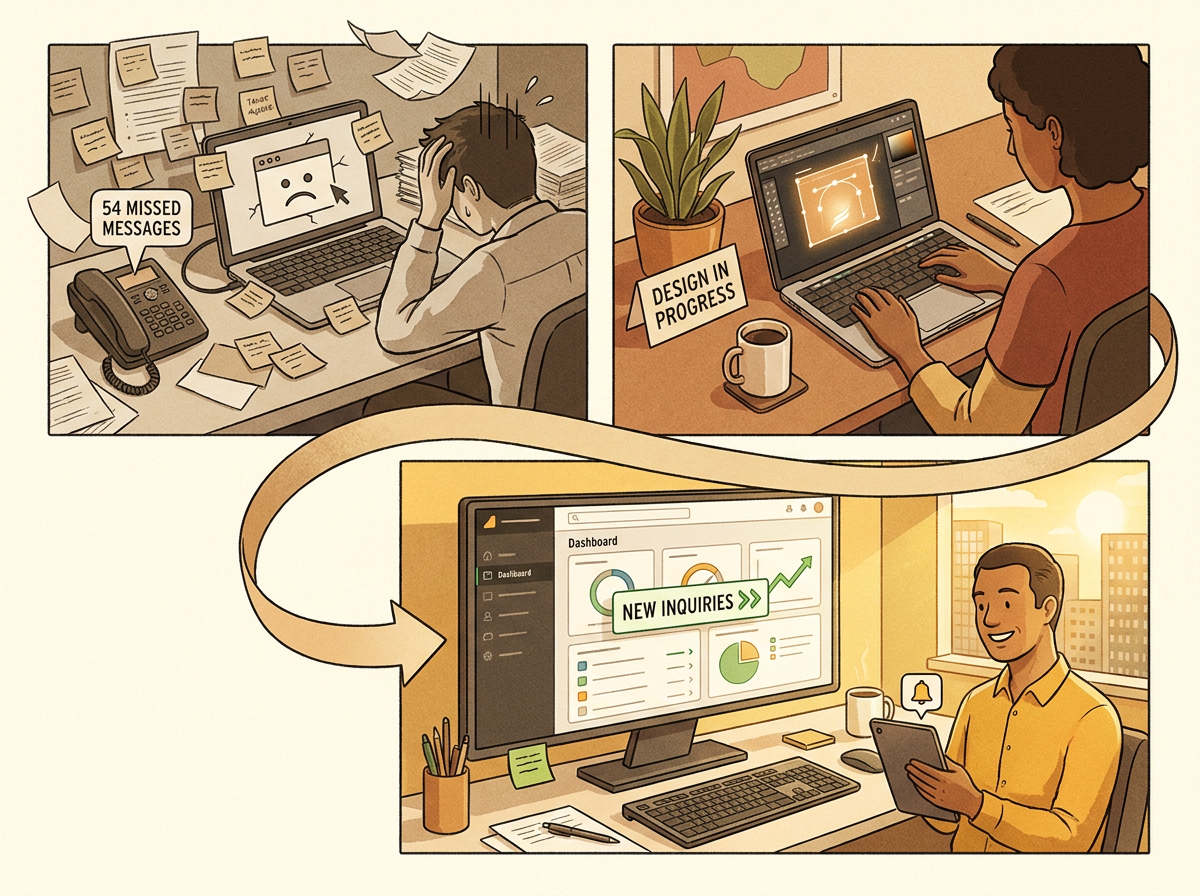
Before: The Assembled-Over-Time Website
Most small service businesses arrive at their digital presence the same way. First, someone told them they needed a website, so they got one — a cousin built it, or they used a builder template, or they hired someone cheap and fast. It works in the sense that it exists. It fails in most of the ways that matter.
It doesn't show up in local search results reliably, because nobody who built it thought about SEO structure. It loads slowly on mobile, which is where most local searches happen. The contact form submits to a general email inbox that may or may not get checked promptly. There's no AI assistant, no automated response, no way for a customer to get any information after business hours. When a potential customer lands on it at 8pm with a question, they get silence.
The owner knows something is off. The phone doesn't ring the way referrals did before. They've tried a few things — a Google Business Profile, a Facebook ad that ran for a month — but nothing quite connects. The problem isn't any one piece. It's that the pieces were never designed to work together.
After: The Intentional System
Done right, the digital presence isn't a collection of parts. It's a connected system, and every piece was built with the question "what happens next?" in mind.
The site is built for local search from the start. Not as a layer added later, but baked into the structure: service area pages that name the specific cities and zip codes served, content that answers the questions local customers actually search, technical structure that search engines read correctly. The business shows up when someone nearby searches for what it offers.
The AI assistant handles the first conversation. A customer lands on the site at 9pm, has a question about whether a service covers their neighborhood, and gets an immediate, accurate answer — because the assistant was trained on the business before launch. It knows the service area, the services offered, the pricing approach, the most common customer questions. It collects contact information, qualifies the lead, and sets the expectation for follow-up. Nothing falls into an after-hours gap.
The contact flow actually goes somewhere useful. Inquiries route to the right place. A follow-up is triggered automatically so that leads don't go cold while the owner is on the job. The customer who submits a form at 7am gets an acknowledgment and a timeline, not silence until someone checks email.
The design builds trust immediately. Within thirty seconds of landing on the site, a visitor can tell this is a legitimate, professional operation. Clean layout. Clear service descriptions. Trust signals — licensing, service area, how the process works — front and center, not buried. Before-and-after photos that show the actual work. A human presence behind the business, not just a logo and a phone number.
!A timeline showing the shift from improvised digital presence to intentional infrastructure.
What "Done Right" Costs in Time
The thing that surprises most clients is how much simpler the ongoing reality is once the infrastructure is in place.
Before, a significant amount of the owner's mental bandwidth went to managing digital fragmentation — updating a site they could barely edit, responding manually to every inquiry, wondering why they weren't showing up in searches, trying to figure out if the Facebook ad was working. It was a slow leak of time and attention that never quite added up to anything.
After, those things mostly run themselves. The site doesn't need constant attention because it was built correctly. The AI assistant handles the first-contact layer without owner involvement. Leads come in through a clear channel and get routed appropriately. The owner's attention is freed for the work that actually requires it.
This is what "done right the first time" delivers: not just a better website, but a reduction in the ongoing tax that a broken digital system places on an owner's time and energy.
The "Fix It Later" Problem
The most common reason small businesses don't do this sooner is the assumption that they'll fix it later — when things are less busy, when there's more budget, when it feels like the right time.
Later rarely comes. Busy seasons stay busy. Budget priorities shift. The broken website keeps quietly losing leads that nobody can see or count. And when later finally does arrive, the rebuild costs more than doing it right would have — because years of accumulated shortcuts have to be untangled before anything new can be built properly on top of them.
The businesses I've seen get the most out of a well-built digital system are the ones that stop waiting for the right moment and start from the premise that the infrastructure is a business asset, not a nice-to-have. Every month of delay is a month of leads that went somewhere else, and a month of the owner's time spent managing something that should be managing itself.
Done right the first time is not a luxury position. It's a practical one. The compounding returns start immediately — and they keep running long after the initial investment is forgotten.
If you're ready to stop waiting and build the infrastructure your business deserves, let's start the conversation. Ember Pulse Studios at emberpulsestudios.com →