
There's a capability that large companies take completely for granted — one that gives them a consistent, compounding advantage over their smaller competitors. It's not their budget. It's not their brand recognition. It's not even their talent.
It's the fact that they think in systems.
A mid-sized regional service company doesn't leave lead capture to chance. It has a defined process for how an inquiry becomes a booked job. It knows where leads come from, what happens to each one, and how long the average conversion takes. When something breaks down, the system makes the breakdown visible, and someone fixes it.
Most small businesses operate nothing like this. And the gap — the compounding cost of doing things ad hoc, one situation at a time — is larger than most owners realize.
What Systems Thinking Actually Means
Systems thinking is not a management philosophy or an MBA concept. In its most practical form, it's simply this: looking at your business as a set of connected, repeating processes — and deliberately designing those processes so they produce the results you want.
It means asking: when a new customer finds me, what happens next? Is that a defined sequence of events, or does it depend on who picks up the phone and what mood they're in that day? When a quote request comes in after hours, where does it go? When a job is completed, what happens to that customer relationship — is there a system to follow up, ask for a review, offer a seasonal service? Or does it just end?
Most small businesses, if they're honest, answer these questions with some version of "it depends" or "we handle it as it comes up." That's not a criticism — it's the natural state of a business that grew through hustle and relationship, not design. But it comes with real costs.
The Winging-It Tax
Every business that operates without deliberate systems is paying what I think of as the winging-it tax. It shows up in predictable ways.
Leads fall through the cracks. A quote request comes in on a Saturday, sits in a general inbox, and gets answered on Monday afternoon. By then, the customer has already hired someone else. Nobody is to blame. There was just no system to catch it.
The owner becomes the bottleneck. When processes live in the owner's head instead of in defined workflows, nothing happens without the owner. Growth stalls not because of demand but because the owner is the system — and one person can only do so much.
Quality varies. When delivery depends on individual judgment rather than defined process, the customer experience varies based on who handled their job and how they were feeling that day. Some jobs go great. Others fall short for reasons that are hard to diagnose because there's nothing systematic to examine.
The cost of scaling is enormous. When the time comes to hire, train, or hand off responsibilities, there's nothing to hand off. The new employee has to learn from watching the owner, which means the owner has to remain deeply involved for longer than makes sense.
These costs are real. They're also largely invisible — especially when business is going well enough that the pressure to fix them never quite rises to the top of the priority list.
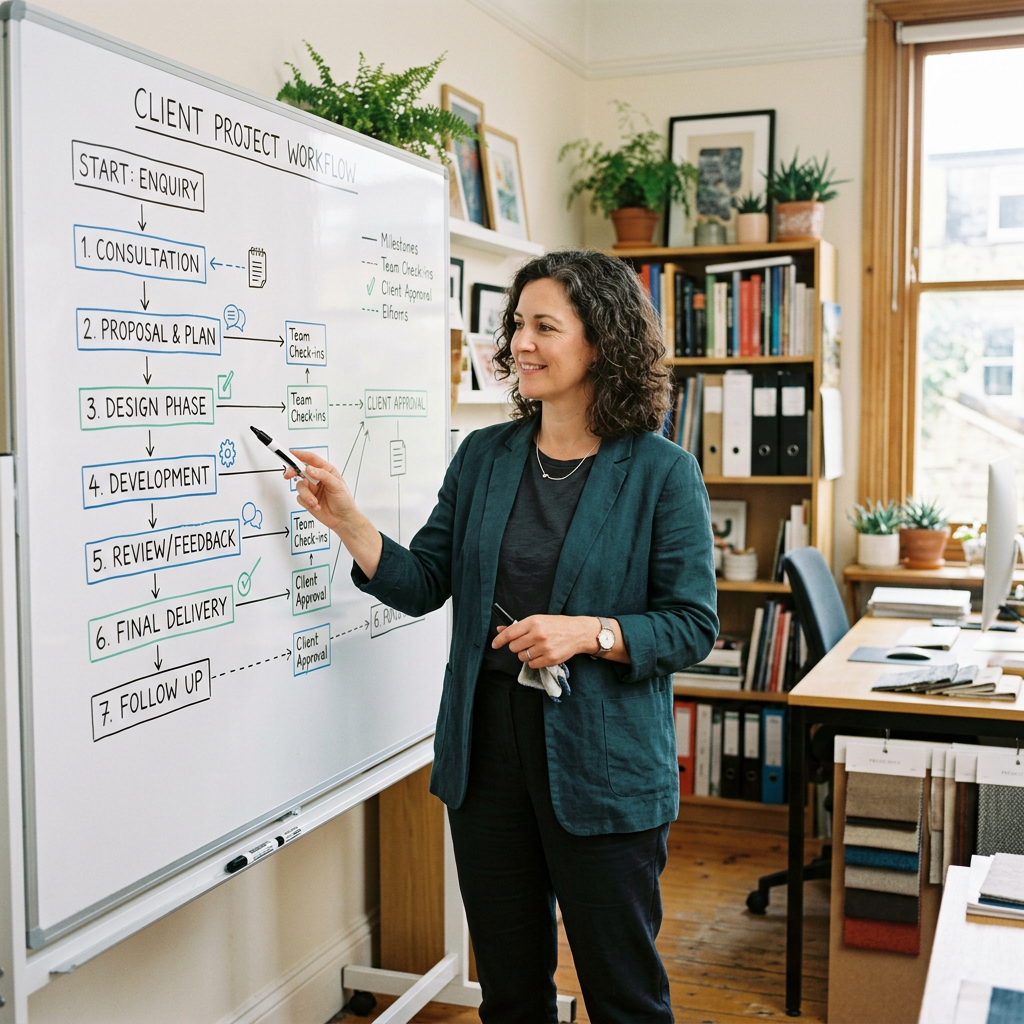
!A small business owner reviews a clear process diagram on a whiteboard.
Three Places Systems Change Everything
You don't have to redesign your entire business to capture most of the benefit. In my experience, there are three places where building a deliberate system creates outsized returns for a small service business.
Lead capture and response. The window between a customer getting interested and a customer booking with someone is often measured in minutes, not hours. A system that captures inquiries automatically — through an AI assistant on your website, an automated acknowledgment email, a clear path from contact form to follow-up — compresses that window dramatically. This alone can change your conversion rate without changing anything else about your marketing.
The customer journey after contact. Most small businesses have a decent process for doing the actual work. Fewer have a defined process for what happens after first contact: how a lead gets qualified, how an estimate gets delivered, how a follow-up is triggered if the customer doesn't respond. Closing this gap — turning the post-contact sequence from ad hoc to systematic — is where a lot of revenue gets recovered.
Reputation building. Reviews are the most powerful marketing tool a local service business has. They're also almost entirely dependent on asking — and most businesses ask inconsistently, if at all, because there's no system that prompts the ask at the right moment. A simple automated sequence that goes out after job completion can double the review velocity of a business without any additional marketing spend.
This Is What Ember Pulse Studios Builds
I think about every engagement as an infrastructure problem. Not just "what should this website look like" but "how does this business capture leads, convert them, and retain customers — and what does the technology need to do to support that?"
The websites we build aren't brochures. They're the front end of a connected system: a professional presence that shows up in local search, an AI assistant that handles the first conversation, a lead capture flow that doesn't drop anything, and a structure that can actually hand work off to the owner rather than depending on the owner to power everything manually.
This is systems thinking applied at small business scale. It's not complicated. It's just deliberate — and it produces a compounding advantage that gets more valuable the longer it runs.
Ember Pulse Studios builds connected digital systems for local service businesses — designed to capture leads, convert customers, and work while you're on the job. See what we build at emberpulsestudios.com →