
When people hear that I build websites for small businesses, the assumption is usually that I'm a web developer. I'm not, and I want to explain why that distinction matters — not as a semantic point, but as a practical one that affects what you get when you work with me.
A web developer builds pages. A systems architect builds infrastructure. These are genuinely different things, and the difference shows up in the outcomes.
What Web Developers Optimize For
Web developers are skilled at a specific set of things: writing clean code, creating visually accurate implementations of designs, building pages that load correctly across browsers and devices, and delivering files on time. These are real and valuable skills. The best web developers do this work with precision and care.
But what web developers are typically optimizing for is the artifact — the website itself. Does it look right? Does the code work? Is it delivered on schedule? Those questions are important, but they're not the full picture.
The questions that actually matter to a small business owner are different. Does this website generate leads? Does someone who finds my business through Google feel confident enough to reach out? When they do reach out, does anything happen automatically to keep them engaged until I can follow up? Does the site work as part of how my business runs — or is it a separate thing that sits off to the side?
Web developers don't typically ask those questions. They build what they're asked to build. The strategic thinking about how the website connects to the rest of the business — that's usually left to someone else, or left out entirely.
What a Systems Architect Thinks About
I spent years building real digital systems for organizations far larger than the clients I now serve: infrastructure that handled thousands of daily transactions, connected multiple platforms and data sources, and had to keep working reliably regardless of what was happening on any given day.
That experience taught me to think differently about any digital project. Not "what does this page need to look like" but "what is this tool trying to accomplish, how does it connect to everything else, and what happens when something goes wrong?"
Applied to a small service business, that thinking produces different questions than a web developer would ask. What happens between the moment someone submits a contact form and the moment they become a booked job? Where does that process break down today? If the owner is unavailable for six hours, does anything happen automatically to keep a lead warm, or does it just sit? When a customer searches for this business on their phone at 8pm, what do they experience, and what does that experience lead them to do next?
Answering those questions — and building something that addresses the answers — is systems architecture. It's a different discipline than web development, and it produces a different kind of result.
!Two diagrams: a website in isolation on the left; a connected business system on the right.
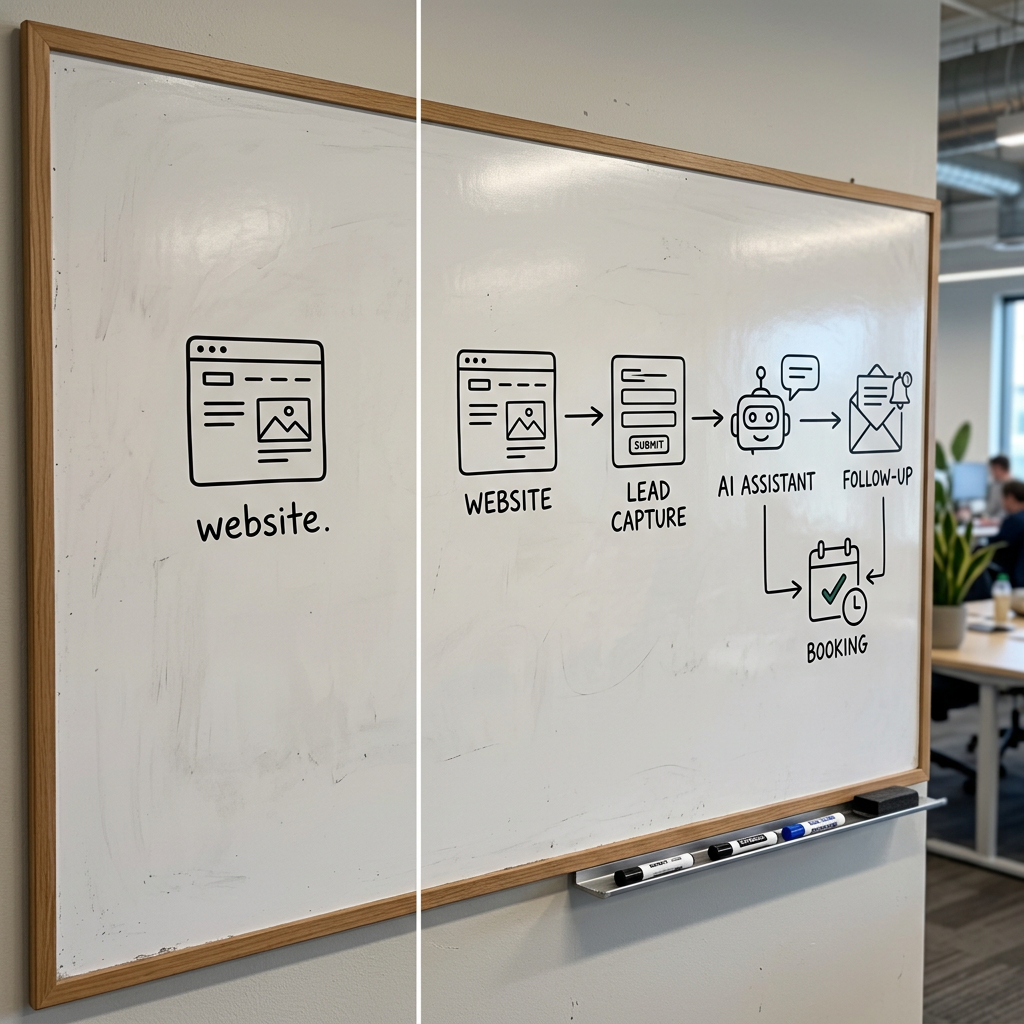
The Practical Difference for Your Business
Here's what this means concretely if you hire a web developer versus a systems architect for your small service business.
A web developer will build you a website. It will probably look professional. It may or may not show up in local search results, depending on whether SEO was in scope. It will have a contact form that submits to your email. When a customer fills it out, an email arrives in your inbox and you respond when you see it. The website is separate from how your business runs; it's a presence, not a tool.
A systems architect builds you infrastructure. The website is the front end of a connected system: it's built for local search from the ground up, so that potential customers actually find it. An AI assistant handles the first conversation, so leads don't disappear into after-hours gaps. The contact flow routes inquiries to the right place and triggers follow-up automatically. Every piece was designed with the question "what happens next?" in mind, not just "does this look right?"
The site doesn't just exist — it works. It generates leads while the owner is on the job. It captures inquiries at 11pm on a Saturday. It makes the business look and function like an operation that has its act together, because the infrastructure actually does have its act together.
Why Small Businesses Have Never Had This
For a long time, systems-level thinking was reserved for organizations with dedicated technology teams and enterprise budgets. Small businesses got web developers because that was the affordable option — and web developers gave them websites, not systems, because that's what the engagement called for.
The tools have changed. AI assistants that used to require enterprise contracts are now accessible to any business willing to invest in building them properly. The gap between what large organizations can do digitally and what small ones can do has narrowed significantly.
What hasn't changed is that someone has to know how to put the pieces together. A platform gives you tools. A systems architect gives you a connected, deliberate infrastructure built around how your business actually works and what your customers actually need.
That's what Ember Pulse Studios brings to every engagement. Not pages. Systems. Not a website that exists, but a business tool that works.
I'm not a web developer. I'm the person who builds the infrastructure your business has been missing. Let's talk at emberpulsestudios.com →